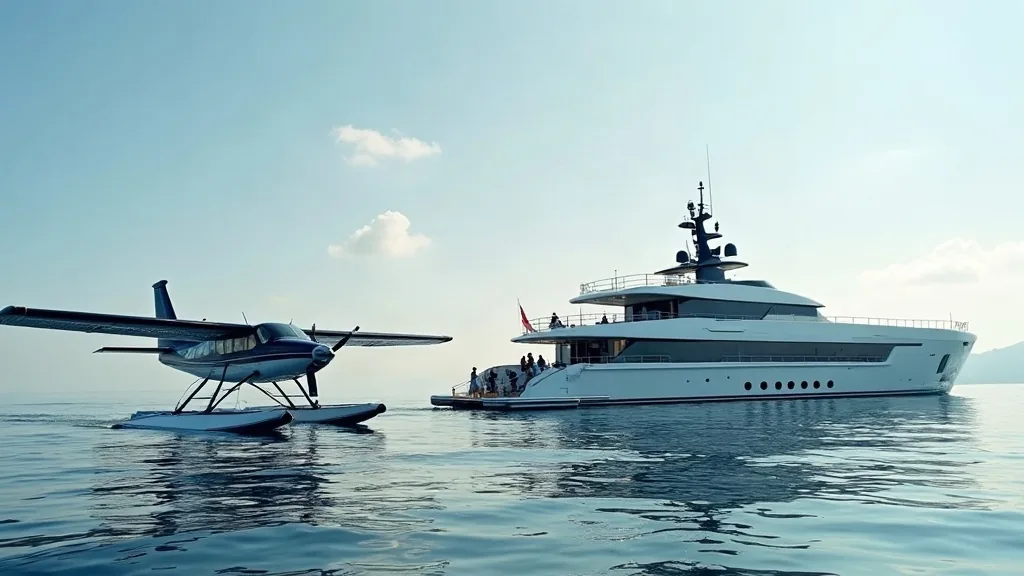
A Bali yacht rendezvous seaplane charter flies guests from Ngurah Rai International Airport to a water landing point near — never onto — a yacht, superyacht or phinisi, where a tender collects them. The Cessna Caravan 208 EX Amphibian used on these routes seats up to 8 guests, whole-aircraft charter only, and the rendezvous point is chosen by sea state and operator approval, with Benoa’s marina apron the most common pickup given the harbor’s growing berth capacity.
Guests booking a Bali-Komodo multi-night charter, a phinisi embarkation day, or a superyacht owner’s party arriving separately from crew all use this format instead of a road-and-tender combination that can add hours to a transfer. The aircraft does the distance work in about 50 minutes for a standard South Bali leg; the tender does the last few hundred meters.
Where can the aircraft meet the yacht?
Three places, in order of how often they’re used. Benoa Marina, where the aircraft lands on open water near the harbor frontage and a tender bridges the gap to a berthed vessel. A sheltered bay near an anchorage — Benoa bay, water off Nusa Dua, or a similar lee shore — when the yacht is at anchor rather than berthed. And a matched coastal point for liveaboard embarkation days, picked to align with where the phinisi or dive liveaboard actually starts its itinerary.
None of these is a beach landing on demand. Amphibious capability means the aircraft can use either the airport runway or water, not that it can put down wherever a guest points on a map — every water landing needs operator sign-off and a workable sea state on the day, and Indonesia’s dry season (April–October) gives calmer water and more reliable scheduling than the wet season (November–March), when cancellation risk rises.
The Bali Maritime Tourism Hub under development at Benoa is the reason Benoa increasingly anchors this routing. As of September 2026, the project’s stated plan is capacity for roughly 180–188 yachts including superyachts to about 90 meters, immigration and provisioning services, and up to five cruise ship calls per day, with waterfront business and MICE zones phased toward Q4 2027 and full launch stated for end-2028. Treat every part of that as a plan and a forecast, not a completed fact — the hub is not finished, and this desk reports its status rather than claiming any part of it as built.
Who talks to the captain?
Not the guest, directly — the coordination desk does, and that’s the point of booking a rendezvous rather than assembling one yourself. The desk confirms the captain’s preferred pickup window against tide and vessel position, assigns a VHF channel between the tender crew and the ground team (the tender talks to the aircraft’s ground handler, not to the aircraft in flight), and times the tender’s launch to touchdown rather than to takeoff, so the vessel isn’t holding station longer than needed.
Two coordination tables cover what actually has to happen and who owns each piece.
Table 1 — Rendezvous formats
| Format | Where it happens | Typical lead time | Best suited to |
|---|---|---|---|
| Marina pickup | Benoa Marina apron/water frontage | 48–72 hours | Yachts already berthed at Benoa |
| Bay tender pickup | Sheltered bay near anchorage (Benoa bay, off Nusa Dua, similar lee water) | 3–5 days | Yachts at anchor, no berth assigned |
| Liveaboard embarkation day | Coastal water point matched to the liveaboard’s own start point | 5–7 days, weather-dependent | Phinisi and multi-night liveaboard departures |
Table 2 — Coordination checklist
| Step | Who owns it | Why it matters |
|---|---|---|
| Confirm rendezvous window | Yacht captain | Tide, sea state and vessel position set the window, not guest preference |
| Assign VHF channel | Tender crew + ground handler | Keeps tender timing synced without guessing |
| Time tender launch to touchdown | Tender crew | Vessel doesn’t hold station longer than necessary |
| Submit passenger and luggage manifest | Concierge desk | Weight distribution matters on an 8-seat aircraft |
| Approve water landing point | Seaplane operator + relevant authority | Sea state and operator sign-off decide the point, never guest choice alone |
Seaplane or helicopter for a yacht with no helideck?
Seaplane, in most cases — a helicopter needs a helideck or a cleared helipad-equivalent space, while a seaplane lands on open water near the vessel and lets the tender do the connecting work. That’s the practical dividing line: if the yacht has no helideck, the seaplane rendezvous is usually the only air option that reaches the vessel directly.
Helicopters remain the better choice for vessels that do carry a helideck and want direct touchdown without a tender leg, and private point-to-point helicopter charters are available with varying indicative pricing. Helicopters also carry fewer guests per trip — 4 to 6 seats against the seaplane’s 8.
Table 3 — Rendezvous pricing lines (as of September 2026, subject to change)
| Option | What’s included | Indicative price | Note |
|---|---|---|---|
| Whole-aircraft rendezvous transfer | Charter flight, ~50-minute South Bali block, up to 8 guests, one water landing | Per the operator’s published figures, varying by route and duration, plus separate airport/water-base fees and tax | Fixed per aircraft regardless of headcount |
| Cost-shared among 8 guests | Same charter, split across a full aircraft | Indicative per-guest figure varies by route and full-aircraft cost | Whole-aircraft charter only — seats are not sold individually |
| Resort-partnership reference | Published by a different Indonesian seaplane operator, return charter | A quote-based figure per person, from other operators’ published figures | Cited as a market comparator, not this desk’s rate |
| Helicopter alternative (helideck vessels) | Point-to-point private charter | Quote-based, varying by distance and aircraft type | Use when the yacht has a helideck |
A Bali private-jet desk explains combination pricing the same way this desk does: additively. Jet sector plus each seaplane sector, driven by distance, aircraft type and ground handling — the same logic applies when a rendezvous adds a positioning flight, waiting time between legs, or an overnight crew positioning cost. Quote lines to expect: sector block time, aircraft type, airport and water-base fees charged per movement or per passenger, landing/parking/handling at any secondary base, positioning flights, crew duty and overnight positioning, waiting time, taxes, and season.
How booking works
- Share vessel details — yacht or phinisi name, current position or planned anchorage, captain’s direct contact.
- Desk checks landing feasibility — sea state, an approved rendezvous point, and whether tender and aircraft timing actually line up.
- Indicative quote issued — every line item shown separately; the figure stands until deposit, not before.
- Captain and tender crew briefed — VHF channel and pickup window locked in with the ground team.
- Rendezvous day — aircraft lands at the approved point, tender collects guests, yacht proceeds on schedule.
Wider context worth knowing before booking a season ahead: analysts cited in 2026 industry coverage expect Bali private yacht demand to run significantly higher in future years, and Bali-Komodo multi-night charters already commanded significant figures for multi-night trips by August 2026 — figures to plan around, not guarantees this desk makes on any operator’s behalf.
Bali Seaplane Charter is an independent coordination desk operated by Juara Holding Group, established 2015. It does not own or operate aircraft, is not affiliated with any named seaplane or yacht operator, and arranges rendezvous flights through vetted licensed partners. No reviews, ratings or awards are claimed here, and every quote is indicative until deposit.
Ready to line up a rendezvous with your yacht, superyacht or phinisi? Send the captain’s contact and vessel position to the Juara Holding Group desk on WhatsApp at 6281139414563 or bd@juaraholding.com, and get an indicative quote with every fee shown as its own line.
Frequently Asked Questions
Can the seaplane actually land next to my yacht?
Not directly next to it — the aircraft lands at an approved water point nearby, chosen for sea state and operator sign-off, and a tender bridges the last stretch to the vessel. Landing distance from the yacht depends on anchorage depth, other traffic and the operator’s clearance for that spot on that day.
How much lead time does a yacht rendezvous need?
Plan for 48 hours to a week depending on the format: a marina pickup at an already-berthed yacht needs the least notice (48–72 hours), while a liveaboard embarkation day matched to a phinisi’s own schedule needs 5–7 days because weather and the vessel’s own routing both have to align.
What happens if the sea is too rough on the day?
The water landing doesn’t proceed if sea state, wind or daylight don’t meet the operator’s threshold — midday sea breeze affects afternoon legs in particular. The desk rebooks to the next workable window or proposes an alternative pickup point; guests are not asked to accept a landing the operator hasn’t cleared.
Do I need a helicopter instead if my yacht has no helideck?
No — a helicopter needs a helideck or equivalent clear space to land on, which is exactly what a seaplane rendezvous avoids. Without a helideck, the seaplane-plus-tender combination is usually the only direct air option; a helicopter only becomes practical once the vessel has a deck to receive it.
Who pays if the rendezvous point changes at the last minute?
Every quote already itemizes positioning flights, waiting time and secondary-base handling fees, so a genuine sea-state-driven change is priced from those existing lines rather than as a surprise charge. Any material change to distance or aircraft time is confirmed with the guest before it’s added to the final invoice.