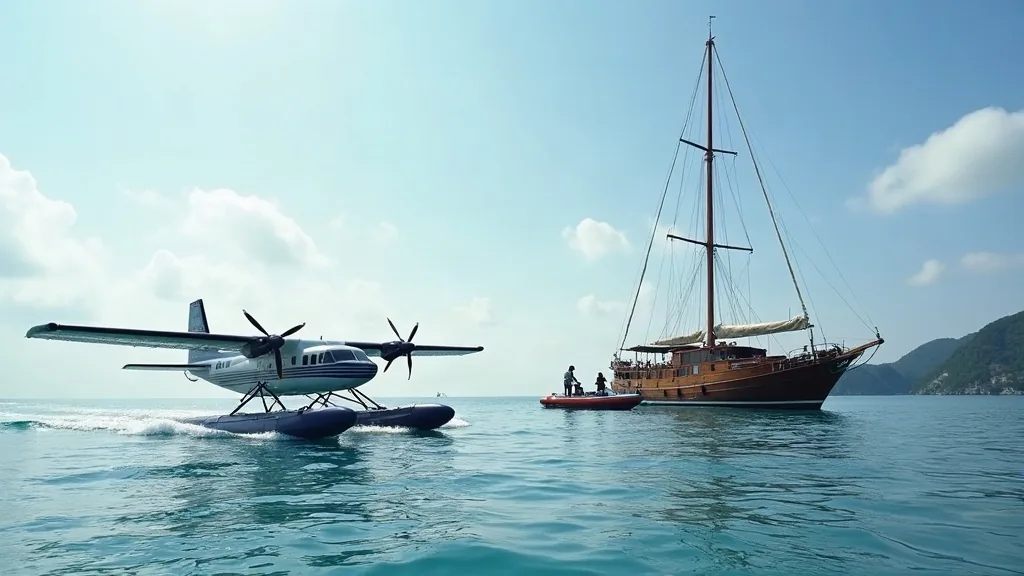
Bali seaplane charters break down into six use-case families — celebration and proposal flights, wedding and photo charters, corporate and incentive groups, golf and villa hops, yacht and liveaboard rendezvous, and multi-leg island days — every one of them flown whole-aircraft on the Cessna Caravan 208EX Amphibian (up to 8 guests) from Ngurah Rai International Airport. The type you pick drives the sea-state window, the permits needed and the quote, not just the scenery.
Most seaplane content in Bali answers “where can I fly to.” This guide answers the question that actually decides your booking: which kind of charter matches what you’re doing — a proposal for two, a 40-person incentive trip, or a rendezvous with a yacht anchored off Nusa Penida — and what each type costs and requires as of September 2026.
Which Six Types Cover a Bali Seaplane Charter?
Celebration and proposal flights. A single-sector charter (roughly 50 minutes) over Uluwatu’s clifftops, GWK, Tanah Lot or the Nusa Penida coastline, timed for golden hour, booked as a private aircraft rather than a shared seat.
Wedding and photo charters. The same aircraft used as an aerial photo platform — low, repeated passes over a ceremony site or a coastal backdrop, sometimes with a photographer occupying one of the 8 seats and a second pass requested for coverage.
Corporate and incentive groups. Multiple rotations of the same 8-seat aircraft to move a group of 16, 24 or more guests in sequence — common for MICE programs tied to Benoa marina events or resort incentive weekends.
Golf and villa hops. A short positioning flight between a golf course near Nusa Dua or Jimbaran and a clifftop villa or resort water-base, replacing a road transfer with a 15-25 minute hop.
Yacht and liveaboard rendezvous. A water landing alongside a chartered yacht or liveaboard anchored off Benoa, Nusa Penida or a Bali-Komodo route vessel, delivering guests or supplies without a marina transfer.
Multi-leg island days. Two or more sectors booked back-to-back in a single day — for example Ngurah Rai to a Nusa Penida water landing, a stop, then on to a second point — priced as a positioning-plus-sector itinerary rather than a single hop.
Type, Duration, Guests and Price Band (2026)
| Charter type | Typical duration | Guests | Price band (as of Sep 2026) |
|---|---|---|---|
| Celebration / proposal | ~50 min, 1 sector | 1-8 (whole aircraft) | Pricing is quote-based per whole aircraft; an indicative per-guest rate for a full aircraft (up to 8 passengers) is calculated from the whole-aircraft price, per an operator’s published scenic rate card, plus separate airport fees and tax |
| Wedding / photo | 50-90 min, 1 sector + repeat passes | 1-8 | Base sector rate plus a repeat-pass or extended block-time line, quoted per itinerary |
| Corporate / incentive | 50 min per rotation | 8 per rotation, multiplied by rotations | Base sector rate x number of rotations needed to move the full group |
| Golf / villa hop | 15-25 min, 1 short sector | 1-8 | Lower than a full 50-minute sector; billed on sector block time and water-base handling, not a flat rate |
| Yacht / liveaboard rendezvous | 30-50 min, 1 sector + water landing at vessel | 1-8 | Base sector rate plus any water-base or handling fee at the rendezvous point |
| Multi-leg island day | 2+ sectors, half-day to full-day | 1-8 | Sum of each sector, plus positioning flights and any waiting time between legs |
A separate Indonesian seaplane operator publishes a resort-partnership return-charter example at a per-person rate, which shows the same aircraft can be priced per-seat under a different commercial model rather than as a private charter — worth asking your desk which model a quote is built on.
What Each Type Needs Before It Flies
| Charter type | Permits / venue approval | Sea-state window | Extra seat (photographer, planner) | Rotations needed |
|---|---|---|---|---|
| Celebration / proposal | Standard water-landing approval only | Standard | Optional | No |
| Wedding / photo | Venue permission if landing near a ceremony site; repeat-pass coordination with the operator | Tighter — repeat low passes need calmer water | Usually yes | No |
| Corporate / incentive | Group manifest and rotation scheduling with the operator | Standard, but multiplied across rotations | Rarely | Yes, 1 per 8 guests |
| Golf / villa hop | Landing-point approval at the villa or resort water-base | Standard | No | No |
| Yacht / liveaboard rendezvous | Coordination with the vessel’s captain and the operator on rendezvous timing | Depends on the anchorage’s exposure to wind and swell | Sometimes, for luggage handling | No |
| Multi-leg island day | Approval at each landing point on the itinerary | Each leg checked separately; a later leg can be scrubbed even if the first flew | No | No, but positioning flights add cost |
Which Type Suits a Couple vs a Group?
A couple booking a proposal or anniversary flight almost always wants the celebration/proposal type: one sector, one aircraft, no rotations, and the flexibility to add a photo pass. A group of 16 or more should plan for the corporate/incentive type from the start, because the aircraft seats 8 and every additional 8 guests means another full rotation — which changes both the schedule and the price. Wedding parties sit in between: the couple and the photographer fly one type of sector, while the rest of the guest list, if included, needs its own rotation booked as a group charter.
When Does a Transfer Become a Multi-Leg Day?
A single transfer — say, resort to airport — is a one-sector charter regardless of which family it falls under. It becomes a multi-leg island day once a second landing point is added to the same booking, such as a Nusa Penida stop before continuing to a second destination, or an outbound and return each treated as separate sectors with a gap in between. The distinction matters for pricing: a Bali private-jet desk explains multi-sector combination pricing as additive — each seaplane sector priced on its own, driven by distance, aircraft type and handling — so a two-leg day is quoted as two sectors plus any positioning flight, not as a single flat rate.
Why Is Every Charter Whole-Aircraft?
The Cessna Caravan 208EX Amphibian used for Bali seaplane charters is chartered as a complete aircraft, not sold seat-by-seat on a fixed schedule. That’s structural, not a pricing choice: water landings depend on an approved point, a workable sea state and operator coordination for that specific flight, so the aircraft can’t run a shared shuttle timetable the way a scheduled airline does. It also means a party of 2 and a party of 8 pay the same aircraft-level charter cost — sharing it across more guests simply lowers the per-guest number, as the per-guest example for a full aircraft shows against the full-aircraft rate.
How Does Pricing Work Across Every Type?
Every quote, regardless of type, is built from the same line items: sector block time, aircraft type, airport and water-base fees charged per movement or per passenger, landing, parking and handling at secondary bases, positioning flights to reach an unusual departure or landing point, crew duty and any overnight positioning, waiting time between legs on a multi-leg day, applicable taxes, and the season. Dry-season months (April-October) generally give calmer water and more predictable scheduling; wet-season months (November-March) carry higher cancellation risk tied to sea state, wind and daylight rather than rainfall alone, which can affect both the quote and the backup plan offered.
How Does Booking Work?
- Tell the desk your type and date. Name the family — proposal, wedding, corporate group, golf hop, yacht rendezvous or multi-leg day — plus guest count, preferred date and any landing points in mind.
- Receive an indicative quote. Built from the line items above; it stays indicative until deposit, and the desk will flag any sea-state or permit condition specific to your landing points.
- Confirm venue and permit details. For weddings, villa hops and yacht rendezvous, the desk coordinates landing-point approval with the operator and, where relevant, the venue or vessel.
- Deposit and lock the slot. Aircraft and crew are scheduled per charter; confirming early matters most in July-August, Christmas-New Year and Easter windows.
- Weather-hold contingency. Because water landings depend on sea state and daylight, the desk confirms the go/no-go window close to flight day and discusses rebooking terms upfront.
Ready to compare charter types for your date? Bali Seaplane Charter is an independent coordination desk of Juara Holding Group (est. 2015); it arranges each charter with licensed seaplane operators and does not own or operate aircraft itself. Message the concierge desk on WhatsApp at 6281139414563 or email bd@juaraholding.com with your guest count, date and preferred charter type for an indicative quote.
Frequently Asked Questions
Can I combine two charter types in one booking, like a proposal flight that ends at a yacht?
Yes — this is booked as a multi-leg island day rather than a single type. The desk prices it as two sectors (the scenic proposal leg, then the rendezvous leg to the yacht’s anchorage), each checked separately for sea state, so one leg can proceed even if a later one needs to be adjusted or rescheduled.
Does a wedding photo charter cost more than a standard proposal flight?
Usually yes, because repeat low passes over a ceremony site add block time beyond a single 50-minute sector, and a photographer often occupies one of the 8 seats. The desk quotes this as the base sector rate plus an extended block-time or repeat-pass line rather than a flat wedding rate.
How many rotations does a 20-person corporate group need?
With 8 seats per aircraft, a 20-person group needs three rotations, since the last rotation carries the remaining 4 guests. Each rotation is priced on the same sector-rate logic as a single charter, so the total cost scales with rotations, not headcount alone.
Can a golf-to-villa hop be booked as a one-way transfer only?
Yes. A golf or villa hop is typically the shortest sector type, 15-25 minutes, and is commonly booked one-way to replace a road transfer. Return legs are quoted as a separate sector, either same-day or on a different date, following the same additive pricing logic as any multi-sector booking.
What happens if sea state cancels a yacht rendezvous leg but not the rest of the day?
Each landing point is checked independently, so a multi-leg itinerary can lose one leg to sea state, wind or daylight while the remaining legs still fly. The desk discusses rebooking or route-adjustment options for the affected leg once conditions are confirmed closer to flight day.